







Originally published on CDM.press
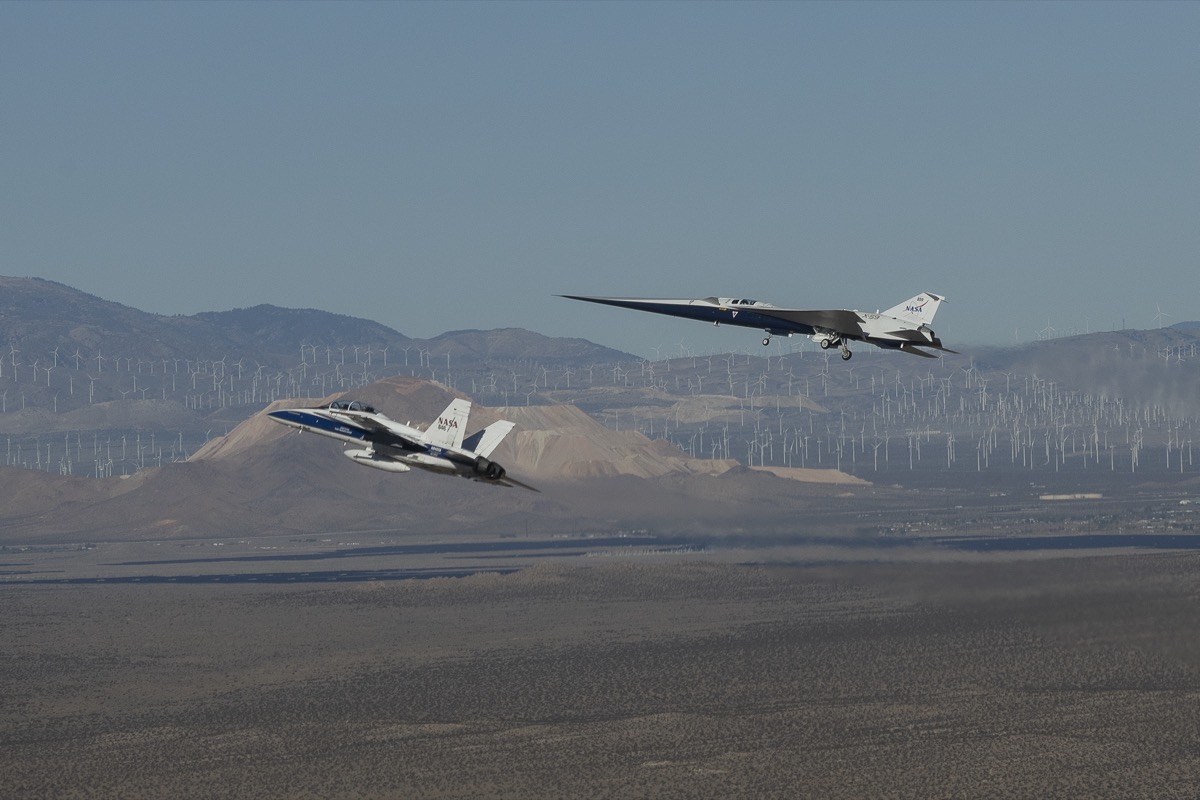
NASA's X-59 Quiet Supersonic Test Aircraft departed from Edwards Air Force Base, California on October 28th, exactly one year from its first flight, and began its first cross-country trip.
After leaving Edwards Air Force Base the quiet supersonic aircraft X-59 stopped in El Paso and at Naval Air Station Joint Reserve Base Fort Worth before arriving at Birmingham-Shuttlesworth International Airport in Alabama on the following day, Avweb reported, referring to flight data. Departure from Fort Worth was at 9:48 a.m. CDT. Arrival in Birmingham was at 11:03 a.m. CDT. No time of arrival has been published yet for Kennedy Space Center. According to reports by AIN Online and The Aviationist the X-59 is headed to Kennedy Space Center for a static display at NASA's MAX POWER aerospace expo and air show on November 7-8.
Nils Larson and NASA test pilot Jim "Clue" Less are flying the X-59 on this cross-country leg with an F-15 and an F/A-18 acting as chase planes, reports AIN Online. A NASA Gulfstream was also along for the ride and NASA Administrator Jared Isaacman confirmed on X that the X-59 was headed to Kennedy Space Center, The Aviationist reported. For details on the MAX POWER aerospace expo and air show held at NASA's Kennedy Space Center on Nov 7-8, the agency's event schedule lists an X-59 briefing.
The aircraft was designed and manufactured at Lockheed Martin's Skunk Works facility in Palmdale, California. The aircraft is the main research tool for NASA's Quesst mission, which is gathering data on quieter supersonic flight over land. It is shaped to fly at Mach 1.4 (925 mph) at 55,000 feet and generate a noise similar to a closing car door some 20 feet away. The target noise level for the aircraft is about 75 perceived decibels. That number has not been measured over a community yet.
The long nose of the X-59 does not provide enough space in front of the pilot for a normal windscreen. So instead the pilot looks ahead through a camera-based vision system. The pilot also has side windows for a limited view out.
After a 67-minute test flight on October 28, 2025, during which the X-59 reached an altitude of 12,000 feet and about 230 mph, AIN Online reported, the jet completed its first checkout. The X-59 became supersonic for the first time on June 5, 2026 during an 81-minute test flight. Test pilot Jim "Clue" Less took the plane up to Mach 1.1, about 713 mph, at an altitude of 43,400 feet. "You know you are supersonic when gauges say you are supersonic. I didn't feel anything," Less said, according to NASA.
NASA said the jet has completed 40 additional flights and has reached altitudes above 56,000 feet. It has also reached a top speed of Mach 1.53. Additionally, it has flown the mission condition of Mach 1.4 and 55,000 feet. The next phase is acoustic validation. NASA will use sensors on the ground as well as in the air to measure the sound, then fly the X-59 over selected communities and ask people what they heard.
After the ban of civil supersonic flight over land was introduced by the United States in 1973, NASA now intends to provide the results of the noise tests to the relevant U.S. and international authorities with a view to them considering whether or not to change this decades-old ban. "This is the phase we've been working toward," Larry Cliatt, acoustic validation technical lead for Quesst, said in a September NASA update. "Building and flying a brand-new aircraft is an extraordinary accomplishment, but the next phase is where the real research begins."