










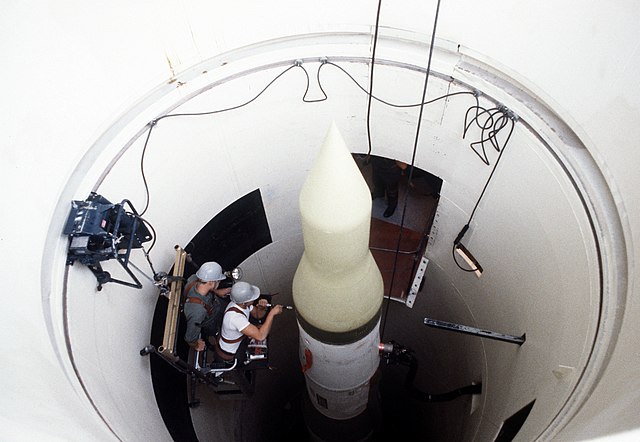
For decades, the Air Force has deployed and operated two elements of America’s nuclear triad – bombers and land-based ICBMs (Inter-Continental Ballistic Missiles). The Navy controls the third leg – submarine-launched ballistic missiles (SLBMs). As a part of deterring missile attacks on America and on US forces overseas, the Army plays a vital role in defending against incoming missiles.
Recently, highlighting the Air Force’s central mission, new Air Force Chief Wilsbach wrote that flying, fixing, and fighting with aircraft is the core of what the Air Force does [Wilsbach-Letter-to-the-Force.pdf ] That emphasis prompted Todd Harrison, American Enterprise Institute, to write this op-ed The time to move ICBMs from the Air Force to the Army is now - Breaking Defense . (Here, note that General Wilsbach also wrote “We will advocate relentlessly for … nuclear force recapitalization through the Sentinel program … [Sentinel is the ICBM modernization program]).

Harrison believes the current Air Force is fundamentally mismatched to the ICBM mission, with today’s ICBM force sliding into disrepair plus a troubled modernization program that is 81 percent over budget and risks undermining credibility of America’s nuclear deterrent. Adding that Air Force does not have the bandwidth to modernize its fighters, bombers, tankers, and ICBMs simultaneously, and noting positives about Army missile expertise (e.g., growing emphasis on long-range fires), he recommends that Congress and the administration move this critical mission to the Army now.
He observed that reassigning ICBMs to the Army would give each military department responsibility for one leg of the nuclear triad. This merely symbolic move would be harmful to the extent it detracts from the substantial Army role in defense against missile attacks. On his criticism of the Air Force’s oversight of current ICBMs, driving Air Force to accomplish necessary fixes is far better than pushing silo-based ICBMs into an Army unfamiliar with these systems’ operational and maintenance specifics.
Regarding Harrison’s “relieve the Air Force of an unsustainable modernization burden” by assigning it to the Army, WHOA! In April SecWar directed the Army to implement a comprehensive transformation strategy, streamline its force structure, eliminate wasteful spending, reform the acquisition process, modernize inefficient defense contracts, and overcome parochial interests to rebuild our Army, restore the warrior ethos, and reestablish deterrence. [2025 Army Transformation Initiative (ATI) Force Structure and Organizational Proposals: Background and Issues for Congress | Congress.gov | Library of Congress] The Army is now readjusting after deactivating its seven-year-old modernization-focused Army Futures Command and combining its essence with the also-deactivated Training and Doctrine Command into a new organization called the Transformation and Training Command, or T2COM. [Army Futures Command shuts down]

It is the Army that would likely be facing an unsustainable burden if ICBM modernization were to be thrown into its latest transformation and formidable jobs list. Further, a move like this would divert Air Force leaders and affected personnel from their primary air, missile, and space activities to help ensure the transfer was handled properly. It would also disrupt the recent elevation of Sentinel oversight to the office of Deputy SecWar [read full story ]. As a result, the next several years could be perilous with a third of America’s nuclear triad being shuffled to a very busy Army from a very busy Air Force.
Conclusion: moving ICBMs from Air Force to Army is a bad idea, now and in the foreseeable future.
However, there is a twist: suggestions have arisen that part of the ICBM modernization effort should involve mobile rather than silo-fixed missiles. [https://armedforces.press/make-americas-land-based-nuclear-missiles-mobile/] If a part of the future ICBM fleet were to become mobile, coordination with Army long-range-fires expertise during such a development (and perhaps later operation) could be helpful. But that is not a rationale for any immediate or near-term Air Force-to-Army ICBM transfer.








Milley and maggots want THIS so it can handed over to china-HOW does NO ONE know this????
Move tactical air assets to the Army adn reestablish the USAF as the strategic force it was originally meant to be. The Bomber mafia demanded that all AC of the AAF be moved to an independent AF and that has proven to be a bad idea from the start.