







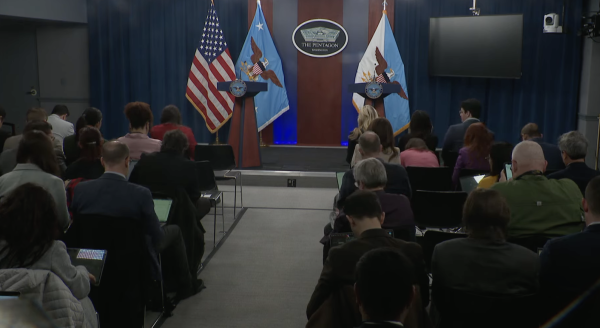
Washington, D.C. — The Defense Department announced Monday it will immediately close the long-standing press workspace known as the "Correspondents' Corridor" inside the Pentagon, relocating journalists to a new annex facility outside the main building.
The move comes days after a federal judge ruled that key portions of the Pentagon's October 2025 media access policy — implemented under Defense Secretary Pete Hegseth — violated the First and Fifth Amendments.
Department spokesperson Sean Parnell said the decision follows an assessment that unescorted access to the Pentagon "cannot be responsibly maintained" without the ability to screen credential holders for security risks, which the court order removed. Journalists will still receive press credentials and be allowed access to the Pentagon for scheduled briefings, press conferences, and interviews, but only with an official escort
"A new and improved press workspace will be established in an annex facility outside the Pentagon, but still on Pentagon grounds, and will be available when ready," Parnell stated on X. He added that the department disagrees with the ruling and plans to appeal while complying in the interim.
The policy change stems from a lawsuit filed by The New York Times in December 2025 challenging restrictions that allowed the Pentagon to revoke credentials for journalists deemed security risks — particularly those who solicited or reported information not officially approved. On March 20, 2026, U.S. District Judge Paul Friedman (appointed by former President Bill Clinton) vacated provisions enabling security screenings and credential revocations based on vague criteria, ordering the reinstatement of passes for seven Times reporters. The judge found the rules unconstitutionally viewpoint-discriminatory and lacking due process.
The original restrictions, approved by Hegseth, required journalists to be escorted, imposed tighter controls on information sharing, and made it easier to revoke badges for unauthorized disclosures. Only a small number of outlets signed on, leading many mainstream organizations to lose their on-site access and prompting the formation of a new press corps with more diverse, including independent and pro-Trump, voices.
The Pentagon Press Association criticized the closure as a "clear violation of the letter and spirit" of the ruling, arguing it undermines traditional access for covering U.S. military operations. Press groups have described the overall approach as an attempt to restrict unflattering coverage amid ongoing national security leaks
The Trump administration has faced repeated leaks related to military matters, including plans involving the Panama Canal, Red Sea deployments, and other sensitive operations. Officials have cited operational security concerns, heightened by deep political divisions and past incidents involving unauthorized disclosures.
The Correspondents' Corridor had served as a dedicated workspace for Pentagon reporters for decades, allowing relatively free movement and interaction with officials. The new arrangement ends that setup for all journalists, regardless of outlet.
The Pentagon maintains it remains committed to transparency while prioritizing the protection of classified information and the safety of personnel. Details on the timeline for the annex and exact escort procedures were not immediately provided.
This development reflects the ongoing tension between national security imperatives and press access in the current administration. The department has indicated it will continue working with credentialed journalists under the revised framework.