







there is danger in simplicity

Today, let’s pick up where we left off yesterday and return to a discussion of the Western Pacific.
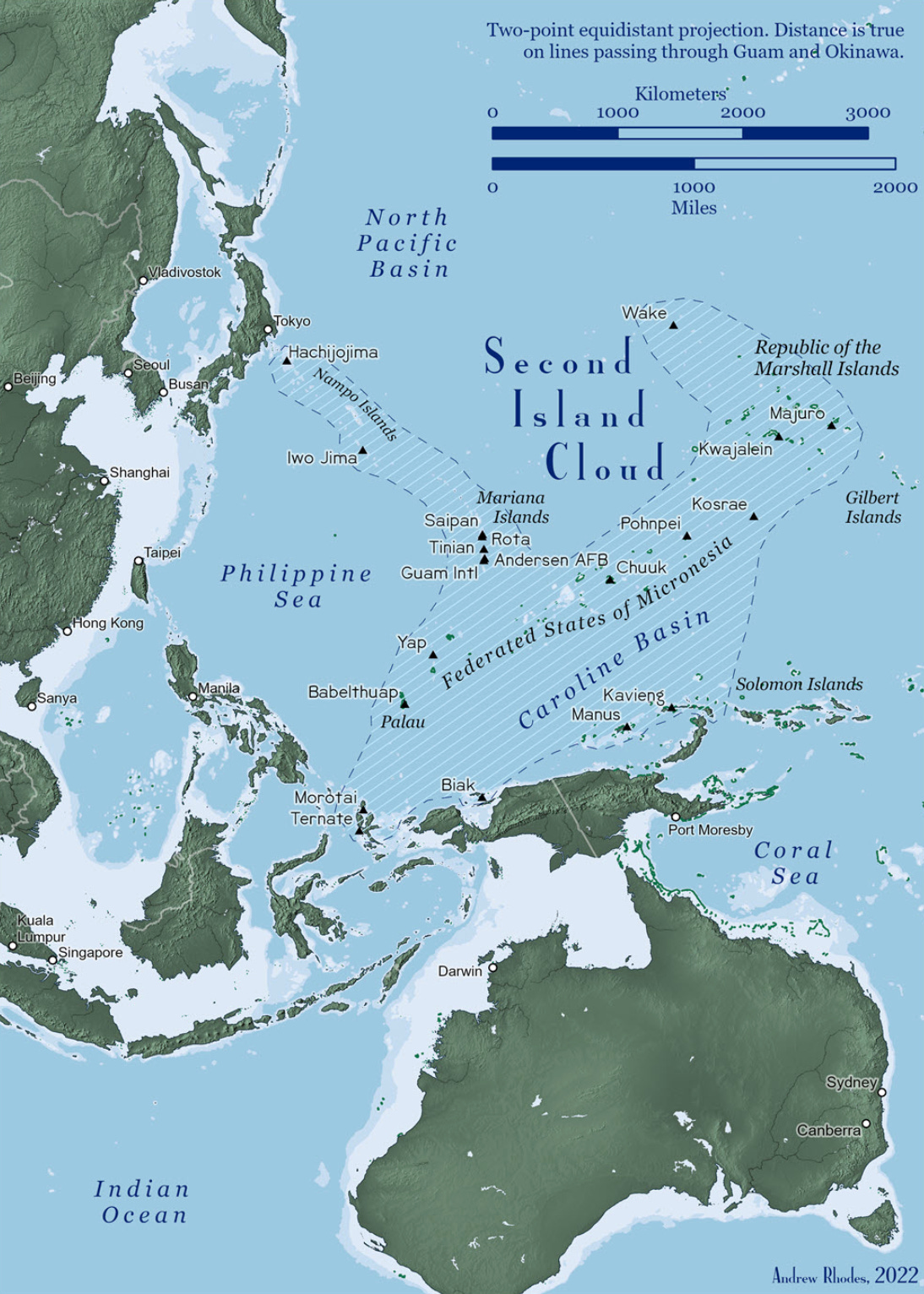
More often than not, things devolve into a discussion of island chains. They are easy to draw and explain—and the First and Second Island Chains have become an expected understanding of the geography of the area.
Is this really the best way to think about it?
Are we really looking at a neat and easy chain, or something a bit more complicated, difficult, resilient, and more open to opportunity for those who understand its true nature?
Do you know who Lieutenant Colonel Earl Hancock “Pete” Ellis, USMC is? You should, we all should. His life story really needs a mini-series like from team that made Netflix’s Death by Lightning, but perhaps that is for another day.
The below is from the 4th Quarter 2019’s Joint Forces Quarterly by Rhodes Cartography’s own Andrew Rhodes, from an essay he wrote while a student at the U.S. Naval War College. It won the Strategic Research Paper category of the 2019 Chairman of the Joint Chiefs of Staff Strategic Essay Competition.
You really should read it in full, but I want to pull out the core of the discussion of Ellis’s view of what we today call the Second Island Chain. It has convinced me that the People’s Republic of China’s strategic planners understand Ellis’s point a lot more than ours do—and they’re acting on it.
In the early 20th century, the visionary Marine officer Earl “Pete” Ellis compiled remarkable studies of islands in the Western Pacific and considered the practical means for the seizure or defense of advanced bases. A century after Ellis’s work, China presents new strategic and operational challenges to the U.S. position in Asia, and it is time for Washington to develop a coherent strategy, one that will last another 100 years, for the islands of the Western Pacific. It has become common to consider the second island chain as a defining feature of Pacific geography, but when Ellis mastered its geography, he saw not a “chain,” but a “cloud.” He wrote in 1921 that the “Marshall, Caroline, and Pelew Islands form a ‘cloud’ of islands stretching east and west.” His apt description of these archipelagoes serves well for a broader conception of the islands in, and adjacent to, traditional definitions of the second island chain. A new U.S. strategy should abandon the narrow lens of the “chain” and emphasize a broader second island cloud that highlights the U.S. regional role and invests in a resilient, distributed, and enduring presence in the Pacific.
…
A growing body of operational literature on new concepts for combat logistics in the Pacific has developed recently, some of it hearkening back to World War II and the anchorages surveyed by the likes of Ellis.26 Expeditionary “forward arming and refueling points” at tertiary airports offer the potential of much more dynamic airpower, particularly with aircraft capable of operating from austere facilities.27 The ability to rearm combatants, and potentially even submarines from support ships in sheltered anchorages, rather than pierside at established bases, offers a new take on an old concept to regenerate naval combat power despite the Western Pacific threat environment.28 All these concepts are directly compatible with the second island cloud concept and would benefit from peacetime infrastructure investment throughout the islands.29
…
Ellis’s description of an island cloud aptly captures the complexity and diversity of the key geography and provides a framework for lasting and dispersed strength—chains fail with a single weak link, but clouds are resilient. The argument for a durable commitment to the second island cloud in the 21st century is much the same as what Ellis wrote in 1913: “Once secure it will stand as a notice to all the world that America is in the Western Pacific to stay.”48
Ellis did not live to see WWII, but his understanding of the geography of the Pacific did, and it applies still today.