







...the 20th century's yesterday...you can care all you want...everybody does, yeah, that's okay

If you’ve been looking for a more substantial reason for the latest news coming from Japan, you’re thinking right.
The last month or so since the new Prime Minister, Sanae Takaichi, took office, you’re hearing a lot of superficial symptoms of a larger issue.
Hardline conservative Sanae Takaichi was voted in by parliament as Japan’s first female prime minister on Tuesday, emulating her hero, Britain’s late leader Margaret Thatcher, after a whirlwind few weeks of political wrangling.
…
She is a regular visitor to the Yasukuni shrine, which honours Japan’s war dead - including some executed war criminals - and is viewed by some Asian neighbours as a symbol of its past militarism.
She also favours revising Japan’s pacifist postwar constitution, and suggested this year that Japan could form a “quasi-security alliance” with Taiwan, the democratically governed island claimed by China.
That last bit got a lot of attention, but should it?
There are still no signs of a diplomatic breakthrough between Tokyo and Beijing following Japanese Prime Minister Sanae Takaichi’s November statement on Japan’s potential role in a Taiwan contingency.
During a meeting of the budget committee in the lower house of Japan’s Diet on November 7, Takaichi said that if China conducted a naval blockade of Taiwan, it would constitute a “survival-threatening situation”, which could prompt Japan to exercise the right of collective self-defense. The content of her remarks was neither new nor surprising: Takaichi has long been a steadfast supporter of Taiwan, and her characterization of a Taiwan crisis as a “threat to Japan’s survival” closely mirrors the stance of her late mentor, Shinzo Abe. Despite China’s strong response, Takaichi has not walked back her comments. Her party’s Vice President Taro Aso recently reiterated his support, noting that she had “merely stated Japan’s position in a concrete manner.”
While Beijing may not be able to get over WWII, almost everyone else is. As the WWII generation is almost gone, so are their ghosts and phobias. In their place, natural and enduring concerns are rising to the surface and exerting themselves.
In the Western Pacific, the rise of China, a society of representative government taking root, nationalism, reliance of the free flow of goods at market prices, and geography—all are shaping modern relationships.
The last few decades’ increasingly positive relationship between Japan and Taiwan is just one manifestation of this growing movement.
Taiwan’s memory of its colonial rule by Japan is, well…complicated…more positive than the Korean-Japanese history. A friend of mine recently moved to Japan. He and his Japanese girlfriend vacationed in Taiwan recently. The one thing he noticed was that without fail, if they were trying to talk to someone who could not speak English, his girlfriend would switch to Japanese and, sure enough, they were off and running. To a person, everyone was happy to meet an American and a Japanese.
I don’t think this is just one or many anecdotal reports.
As both nations face the same primary enemy, that should drive the relationship closer.
There is more than rhetoric backing up the Prime Minister’s comments about using their military if needed.
Japan’s Cabinet on Friday approved a record defense budget plan exceeding 9 trillion yen ($58 billion) for the coming year, aiming to fortify its strike-back capability and coastal defense with cruise missiles and unmanned arsenals as tensions rise in the region.
The draft budget for fiscal 2026 beginning April is up 9.4% from 2025 and marks the fourth year of Japan’s ongoing five-year program to double annual arms spending to 2% of gross domestic product.
…
Takaichi’s government, under U.S. pressure for a military increase, pledged to achieve the 2% target by March, two years earlier than planned. Japan also plans to revise the ongoing security and defense policy by December 2026 to further strengthen its military.
This could not come at a better time. Japan’s military is exceptionally professional. Anyone who has worked with them will tell you. We cannot fight and win in the Western Pacific without our Japanese bases, and if they can grow to a 2%+ of GDP military as well, more the better.
Her economy may be 15% the size of the American economy and 20% of the Chinese economy, but her quality…exemplary. Her social cohesion, almost uniquely strong.
What is driving this story…with some echoes of what brought us to war with each other in the middle of the 20th century—geography.
Yes, it is behind the paywall, but if you want to see the deeper reason Japan appears to have broken through the post-WWII pacifist wall, the article by Niharika Mandhana and Daniel Kiss in WSJ, See How a Chinese Attack on Taiwan Would Be Japan’s Problem, does an exceptional job, mostly through a fundamental—maps.
Let’s start there. In the last few years, when people thought of the “First Island Chain”, their eyes were in the South China Sea. Look north, and you find the Taiwan-Japan connection.
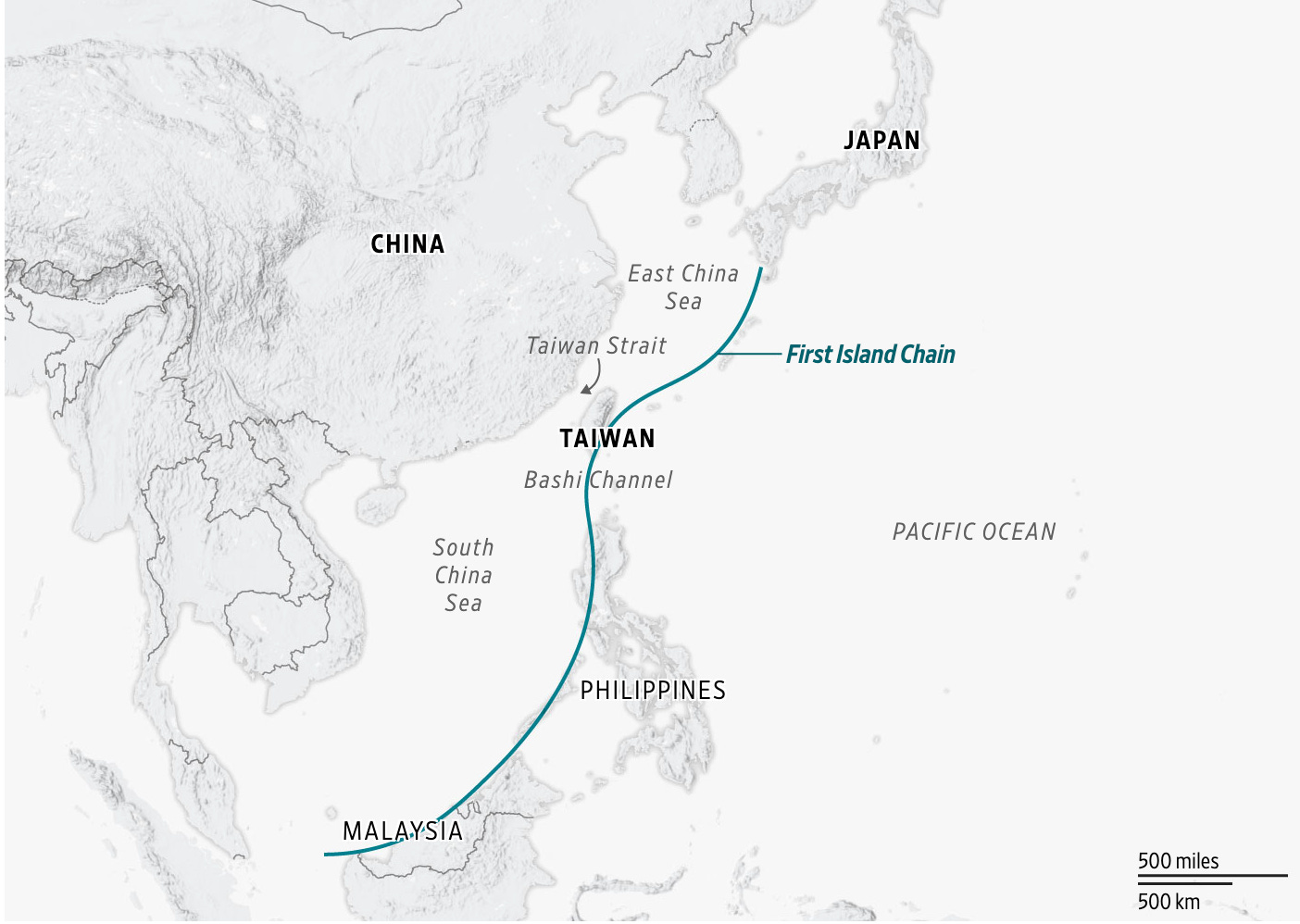
A large portion of global trade passes through the South and East China Seas. Chokepoints like the Bashi Channel sweep Taiwan’s edges.
A successful Chinese conquest of Taiwan would enable Beijing to dominate the region’s strategic waterways, project military power widely into the Pacific and more aggressively pursue its contested maritime and territorial claims.
“The balance of power in Asia would be tipped quite decisively in favor of China should Taiwan fall into China’s hands,” said Robert Ward, Japan chair at the International Institute for Strategic Studies.
Looking seaward, China is “sort of hemmed in” right now, he said, referring to the First Island Chain—a string of archipelagoes off the country’s east coast made up largely of a trio of U.S. partners: Japan, Taiwan and the Philippines. China “clearly wants to break out of that,” Ward said.
It is the center of the line holding China in. When you look just north of Taiwan, it is easy to see how it would be hard for Japan not to be brought in.
In a conflict, Taiwan’s fate would become quickly intertwined with the U.S.-Japan security alliance. To repel a full-scale attack, Taipei would need America—its main defense partner—to join the fight. To fight effectively, American forces would need Japan.
Whether the U.S. would intervene directly in a clash is an open question. Washington maintains a policy of what it calls “strategic ambiguity” to keep China guessing.
Geography presents particular challenges for Japan. A sweep of Japanese islands called the Ryukyus arcs southwest, stopping just short of Taiwan. The island of Yonaguni, more than 1,200 miles from Tokyo, is less than 70 miles from Taiwan.
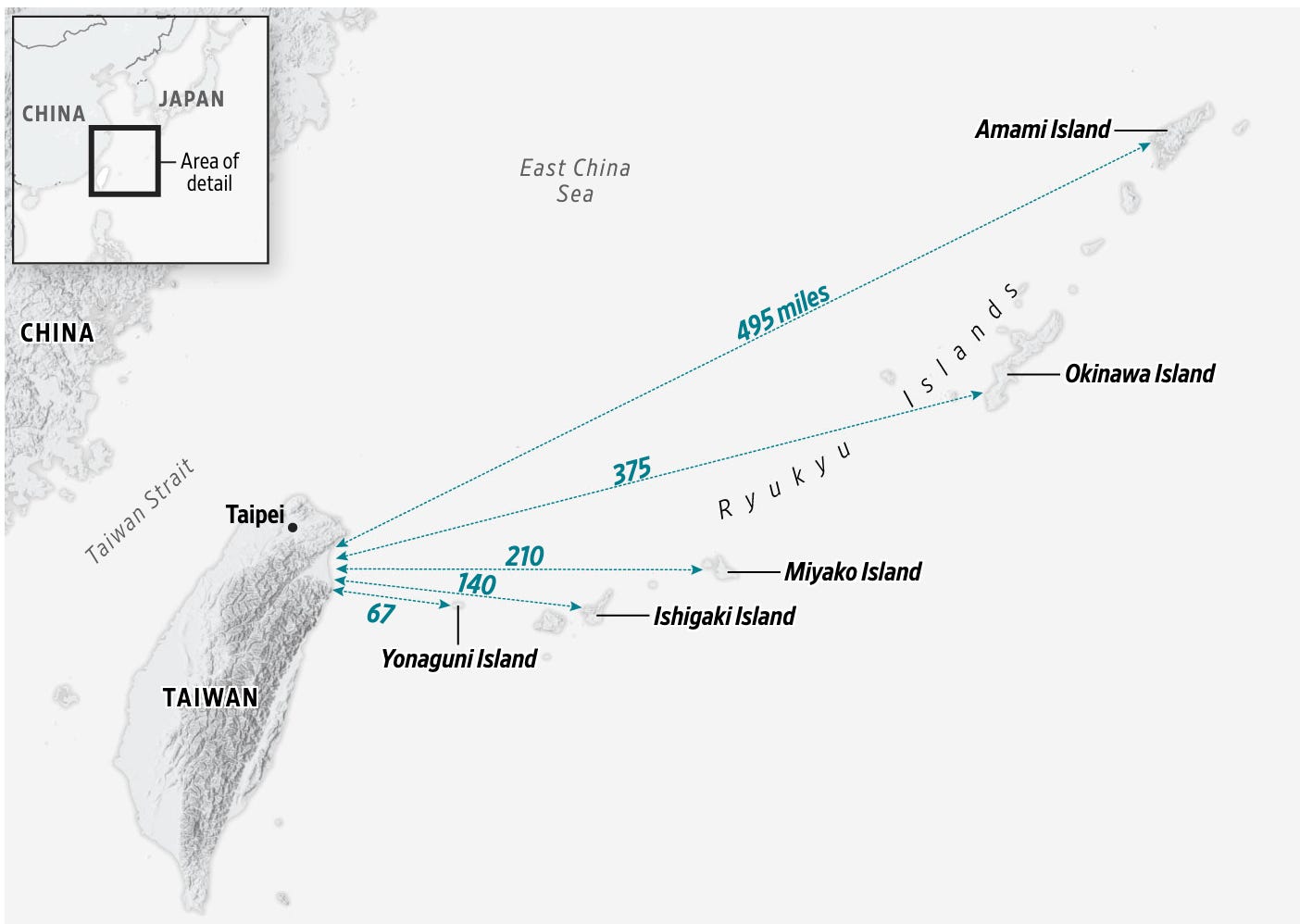
My comment earlier about the essential nature of US bases in Japan? If we could not use them in a fight against China, I’m not sure we have many options.
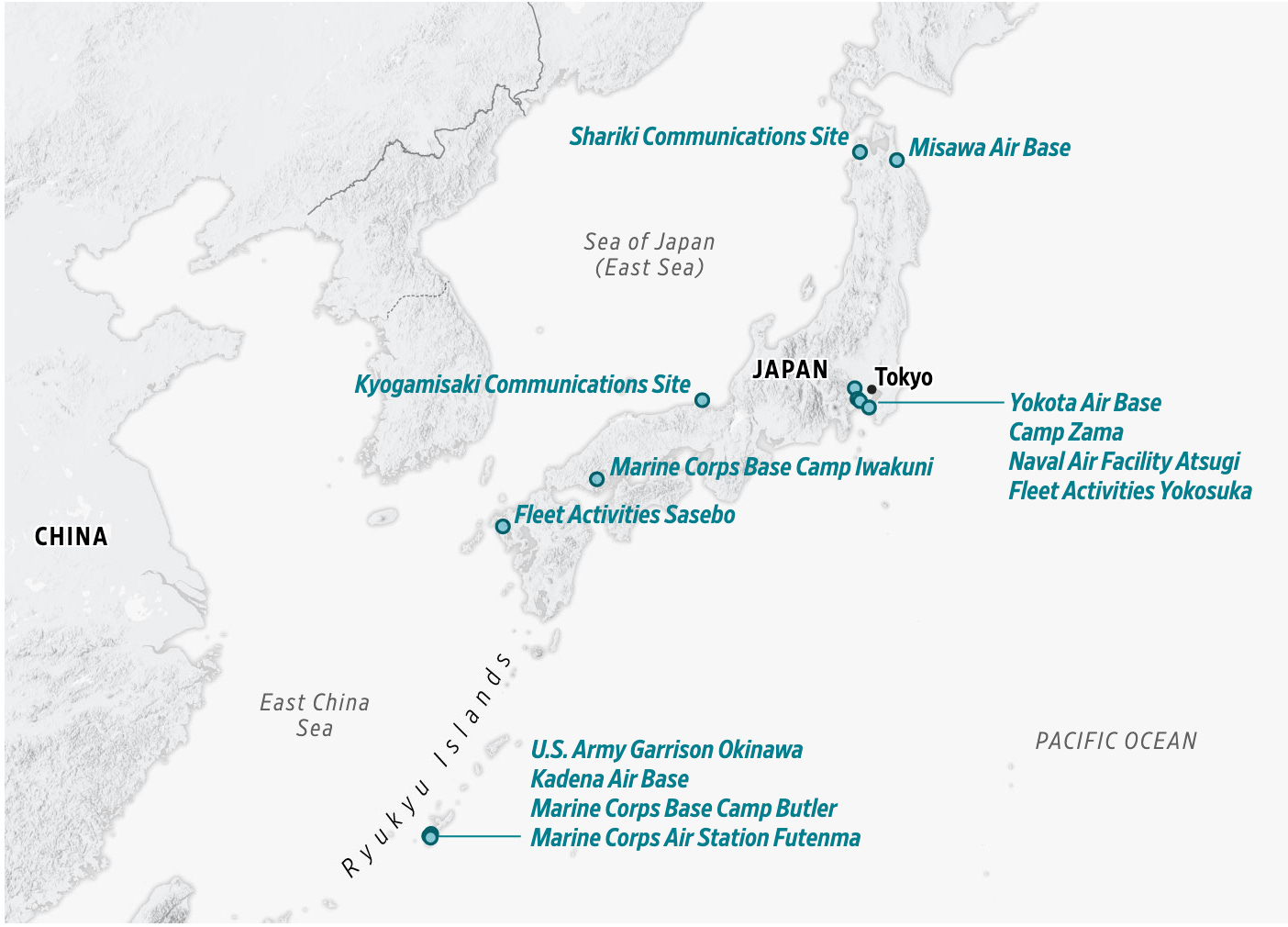
A 2023 report on a Taiwan wargame by the Center for Strategic and International Studies, co-written by Heginbotham, described Japan as the linchpin. “The United States must be able to use its bases in Japan for combat operations,” it said.
One island in particular, Okinawa, is blanketed with military facilities and training areas. Kadena Air Base, located on it, houses a range of aircraft at any given time, including jet fighters that would be needed to sink Chinese ships in the Taiwan Strait and fight Chinese warplanes in the air. A new missile-toting Marine Corps unit designed for an island-hopping fight is also based on Okinawa.
China, of course, knows this, and they have designed their rocket forces specifically to put those bases under threat.
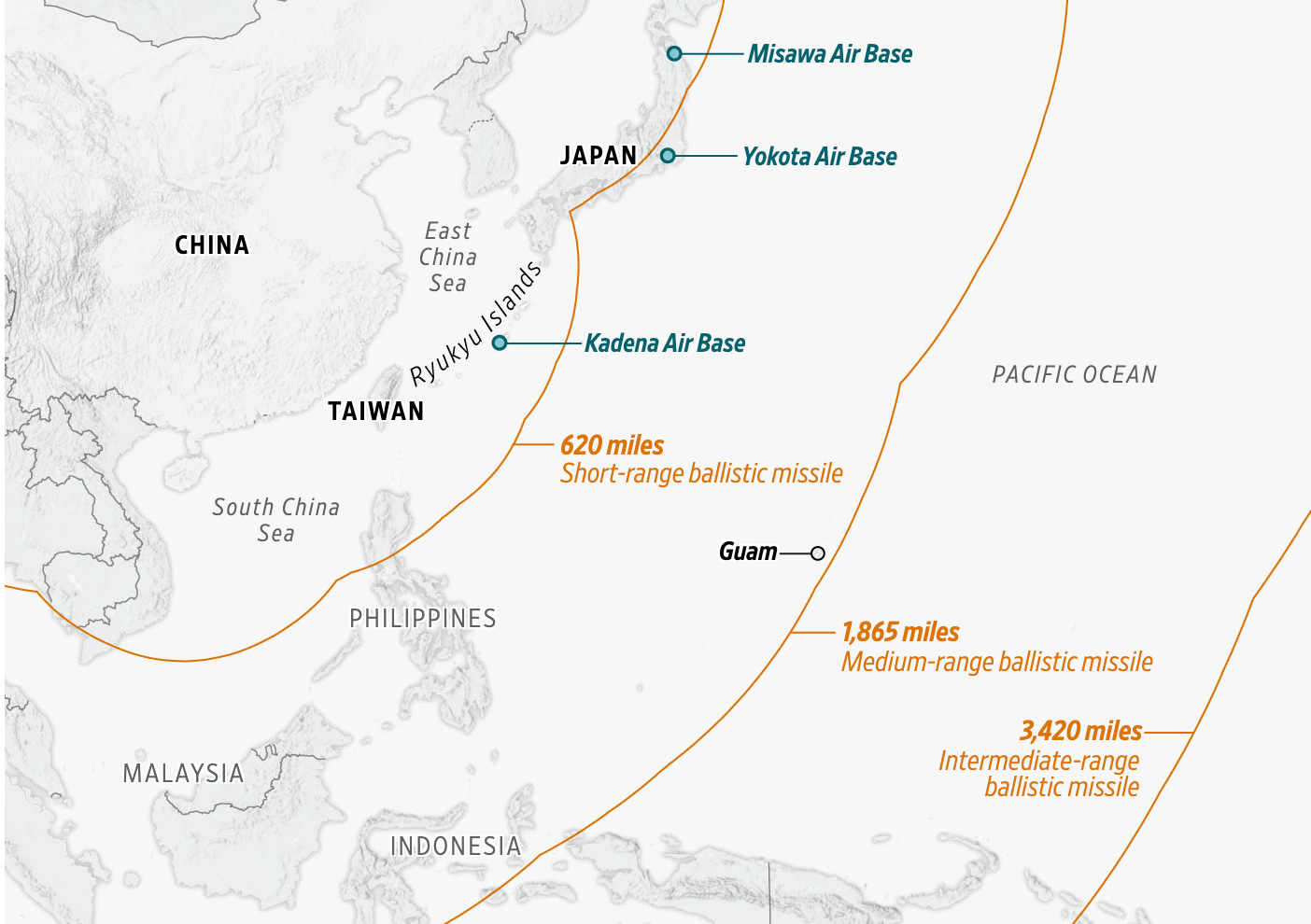
As we’ve discussed here before, such maps are the best sales pitch for naval power you can find. Yes, ships can be targeted at sea…but they move. Those big land bases and supply depots…they’re static.
Build more. Faster. Everyone.