







Why debunking the hype isn’t the same as understanding the requirement

There is a recurring pattern in how we talk about Russian weapons programs, and the MiG-41 interceptor is a clean example of it.
First comes a set of loud, extravagant claims: Mach 5 speeds, anti-satellite weapons, lasers, electromagnetic pulse effects. Those claims are then compared to what our own sixth-generation aircraft concepts promise. Then comes the rebuttal. Analysts and commentators line up to explain why Mach 5 fighters are unrealistic, why lasers on aircraft are impractical, why Russia’s industrial base can’t support such ambition. The verdict follows quickly: the entire program is fantasy, propaganda, science fiction or vaporware.
Our recent commentary likened the MiG-41 to a “Star Wars starfighter”, not a next-generation aircraft at all, but a fictional platform that would look good on a movie screen. At that point, we move on, satisfied that we have seen through the deception.
The problem with this analysis is not skepticism. Skepticism is warranted. The problem is that this is often exactly what the other side wants.
Defense commentary consistently critiques the propaganda layer while ignoring the operational problem underneath.
When we do that, we end up analyzing the rhetoric rather than the requirement. And we risk missing a system that is far more modest, far more achievable, and far more relevant than the headlines suggest.
To understand why, it helps to start not with technology, but with geography.
The real Russian problem: geometry, not glamour
Start with the strategic context as Russia sees it, not as we wish it were.
Russia covers roughly 6.6 million square miles and 11 time zones. It’s Arctic coastline alone stretches more than 15,000 miles. Much of this territory is sparsely populated, lightly defended, and increasingly relevant. Arctic shipping lanes open and long-range reconnaissance and strike systems proliferate. In that environment, time and distance are the core problems. If you want to intercept high-value targets, you have to get there fast.
The MiG-31 was built for exactly this job. It can reliably react within about 400 miles in a 30-minute high-altitude, high-speed profile. From existing bases, with ~140 operational interceptors, this provides coverage for perhaps 60–70% of Russian airspace. That leaves persistent gaps, particularly in the Arctic and Far East. Closing those gaps with the MiG-31 would require either far more aircraft, far more bases, or both.
The geometry is brutal because coverage area scales with the square of radius. If one interceptor can reach 400 miles in 30 minutes, it can “cover” about:
A ≈ πR² ≈ π × 400² ≈ 500,000 square miles per aircraft (idealized geometry)
To blanket Russia with at least two aircraft able to reach any point within 30 minutes, you would need on the order of 260-280 MiG-31BMs distributed across 40–45 bases. Russia doesn’t have that. These airframes are old; most are from the 1980s, the newest was made in 1994. The modernization program buys time, not immortality.
So the core design requirement for a successor isn’t “beat NGAD” or “tick every sixth-generation buzzword.” It’s much simpler:
Go just fast enough, and far enough, that a finite number of aircraft and bases can finally close the gaps.
Once you frame it that way, the MiG-41 stops being a sci-fi toy and starts looking like a very rational, even conservative, answer.
Why speed changes everything
This is where our defense commentary often loses the plot.
Our analysts tend to ask:
Can Russia build the most advanced aircraft imaginable?
Russian military planners most likely ask a different question:
What is the minimum performance increase required so a sustainable fleet size can defend the territory?
Consider what happens if sustained cruise speed increases from roughly Mach 2.5, the MiG-31’s operational regime, to around Mach 3.75-3.85.
A 30-minute intercept radius grows from about 400 miles to roughly 600 miles. That is only a 50% increase in radius, but it more than doubles coverage area. One aircraft at Mach 3.8 can cover roughly the same territory as 2.2 MiG-31s.
Scaled across a fleet, the effect is transformative. With around 140 aircraft operating from 24-26 bases, Russia could plausibly achieve consistent redundant coverage of its airspace. Persistent Arctic gaps narrow substantially. Base count decreases rather than increases. The geometry finally works.
This is the part that “science fiction” dismissals fail to engage with. The question is not whether Russia can build a Mach 5 interceptor with lasers. The question is whether a Mach 3.8 interceptor using conventional long-range missiles and proven materials can solve Russia’s coverage problem.
This is why Mach matters. Not because it sounds impressive, but because it changes the math.
What “next generation” actually means
Much criticism of the MiG-41 revolves around its failure to meet Western definitions of sixth-generation capability. Where is the artificial intelligence? The loyal wingman drones? The networked battle management?
This critique assumes that “next generation” means the same thing in every strategic context.
For the U.S. Air Force, sixth generation emphasizes operating inside contested airspace against peer adversaries: advanced sensor fusion, AI-assisted decision-making, unmanned teaming, and adaptability. Those priorities make sense for air superiority over the Western Pacific.
For Russia, the problem is clearly different. Their primary mission is not penetrating contested airspace, but reaching their own distant airspace quickly to engage high-value targets. For that mission, “next generation” in their book may simply mean:
• Fast enough that coverage geometry works with a finite fleet
• Communications and sensors capable of detecting targets at extreme range
• Missiles that can reach those targets
• Aircraft rugged enough to operate in harsh environments
If an interceptor achieves those goals, it is next-generation for its problem, regardless of whether it matches our feature checklist.
When we accept that and strip away the sci-fi layer, we will be able sketch a physically plausible MiG-31 successor using known Russian technology and historical experience. It is not a technological revolution by any means. But rather an optimization and adaptation.
A realistic MiG-41-class interceptor would probably look roughly like this:
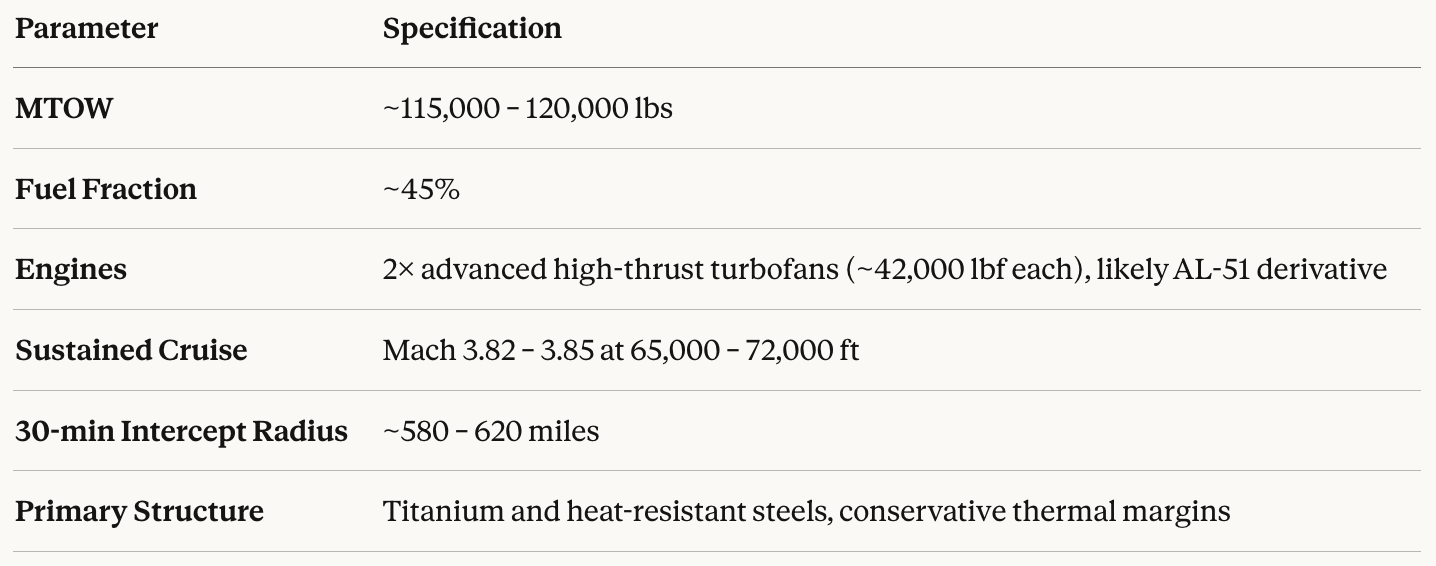
Nothing requires new physics. It requires pushing established high-Mach engineering harder than current Russian service aircraft. It is demanding, but it remains within the envelope of what has already been demonstrated, incrementally improved with modern engines, manufacturing, and systems. And that is precisely why it is so easy to dismiss.
The key question, then, is not can Russia build this, but why would they aim for this specific speed?
The speed story: why Mach 3.85 is “Good Enough”
Think of interceptor speed not as a bragging right, but as a series of thresholds. For MiG-41 to justify development, it must provide:
• Minimum 30-40% coverage improvement over MiG-31
• Address Arctic coverage gap
• Provide capability against peer threats
• Justify financial investment
Option 1: Mach 3.25 – 3.3
This is the comfortable upgrade, it feels reasonable. A noticeable improvement over MiG-31, achievable with relatively modest changes. The problem is that it doesn’t change the geometry enough. Yet, it costs almost as much as a more ambitious design.
Coverage improves, roughly 30 percent increase in radius translates to roughly 70 percent more coverage area. But the gaps don’t shrink decisively. Fleet size and basing requirements barely move. And as such it doesn’t cross the strategic threshold. From a strategic perspective, it is an incremental upgrade with near-strategic costs.
Option 2: Mach 3.82 – 3.85
Here the mathematics begin to favor the investment. At this speed, a 30-minute intercept radius is roughly 600 miles. That is only about 50% more than MiG-31 in linear terms, but more than double the coverage area.
For Russia’s geography, this is the point where:
• The number of required bases drops
• A fleet of roughly 130–150 aircraft can plausibly achieve redundant coverage
• Gaps in the Arctic and Far East shrink substantially
Crucially, this speed is still achievable with known materials and conventional engines pushed hard, but not beyond reason. Thermal loads are severe, but manageable. Maintenance is demanding, but not ruinous.
This is the balance point: fast enough to change the strategic picture, slow enough to remain affordable and sustainable.
Option 3: Mach 4+
Above Mach 4, the curve steepens.
Heating increases disproportionately. Engine inlet conditions push toward more exotic solutions. Time at speed shrinks. Development risk and life-cycle cost climb rapidly.
Most importantly, the geometric payoff diminishes sharply relative to cost and complexity. Going from Mach 3.85 to Mach 4.3 sounds dramatic, but in terms of intercept radius and coverage area, it does not meaningfully outperform the Mach-3.8 class. The map barely changes.
Mach 4 attracts attention. Mach 3.85 changes the map.
Why this approach is easy to underestimate
From the outside, a Mach 3.8 interceptor looks underwhelming compared to visions of sixth-generation fighters packed with autonomy, stealth, and networking.
But that comparison misses the point and prevents us from seeing what Russian planners would consider a success. If a MiG-41-class aircraft enters service in the 2030s, success would look far more mundane than the headlines suggest.
This aircraft is not trying to dominate contested airspace. It would not be Mach 5. It would not carry lasers. It would not dominate space. It is trying to get somewhere fast, from far away, with enough weapons to matter. It does not need to be revolutionary in every dimension. It needs to cross a specific threshold where limited resources can finally cover vast space.
Success for Russian planners would look like sustained Mach 3.7 – 3.9 cruise. A fleet of roughly 140 aircraft. Operational availability in the 75–80% range. Near-continuous redundant coverage across most of Russian territory from fewer bases than the MiG-31 requires.
For Russia’s specific geometry, that would be transformational, not because it introduces revolutionary technology, but because it crosses the mathematical threshold where limited resources can defend the territory.
If that logic sounds familiar, it should be. The United States is maintaining the F-15EX precisely because a large, fast aircraft capable of carrying very long-range missiles remains valuable for homeland defense.
The broader lesson
Whether the MiG-41 program proceeds as planned depends on factors beyond pure engineering: Russian defense budget priorities, industrial capacity, geopolitical developments, and the timeline for MiG-31 retirement.
What seems clear is that Russia faces a genuine operational challenge requiring a solution in the 2030s timeframe. The MiG-31 fleet will age out. The coverage problem will not disappear. If anything, it becomes more pressing as Arctic access increases and peer competitors develop more capable reconnaissance systems.
Some solution will be necessary. Whether it’s the MiG-41 as currently conceived, a modified version, or an entirely different approach remains to be seen.
But the underlying logic is sound: for Russia’s specific problem, a 2x improvement in coverage per aircraft would be genuinely transformational. It’s worth taking seriously, even if the path from concept to operational reality proves longer and more complicated than current timelines suggest.
The lesson for defense analysis is simpler:
Before dismissing a program as technically impossible or strategically irrelevant, ask what problem it’s actually trying to solve.
Sometimes the answer reveals that different strategic contexts demand different solutions, and that “next generation” is whatever gets you across the threshold where your specific problem becomes solvable.
For Russia, that threshold might not require AI or directed energy weapons. It might just require going fast enough that the geometry works out.