







Rebeccah has some ideas
One topic I didn’t expect us to dive into on yesterday’s Midrats with Dean Cheng was the growing nuclear capability of the People’s Republic of China (PRC).
Once the show was over, I figured I needed to pull Rebeccah Heinrichs’s article from Friday up from my ‘read later’ tab.
She gives a solid review of the state of play and offers three suggestions, two of which I generally endorse, and the third a firm non-concur.
First, let’s review the table she sets.
Just three years ago, China denied it was rapidly building up its nuclear arsenal. In 2022, Fu Cong, then the director-general of the Chinese Foreign Ministry’s arms control department (now China’s permanent representative to the United Nations), told reporters that China was maintaining only a minimum deterrent necessary to defend itself.
…China will probably use its new fast breeder reactors and reprocessing facilities to produce plutonium for its nuclear weapons. Just like when China said it was keeping a minimum deterrent and a no-first-use policy, it was lying about this. Chinese officials claimed that these technologies are for peaceful purposes.
The least shocking news on the planet: China lies.
Next we will be assured that none of the 123,000 graduate students at our top research institutions out of the 277,398 Chinese students in the U.S. are connected to the CCP’s security services.
At least the professionals knew what was going on.
Four years ago, then Stratcom Commander Adm. Charles Richard publicly warned that it is more useful to watch what the Chinese are doing than what they were claiming. China was amid what he called a “strategic breakout.”
…
Because of this, Adm. Richard concluded that, while it was impossible to know exactly how Xi Jinping might think about the purpose of the nuclear force, “what matters is they are building the capability to execute any plausible nuclear employment strategy – the last brick in the wall of a military capable of coercion.”
Any successful act of coercion relies on a nation’s adversary believing that it has the capability and willingness to attack. And Beijing is working on a force to convince Washington of that. Not only is China building a large and diverse nuclear arsenal that can reach U.S. ships, bases and allies, it is mixing its nuclear and conventional weapons on dual-capable systems. And China’s strategic nuclear breakout is leading up to the time when U.S. officials have assessed China may try to take Taiwan by force (2027).
Like many parts of the U.S. military, our nuclear forces have been living off the fumes of the solid work of previous generations. As we engaged ourselves in fruitless imperial policing actions in Central and Southwest Asia, the parts of our military that would be needed for the China that was rising to greet the U.S. (remember, I started the Long Game series 21 years ago on the OG Blog and continued it here. The ‘Long Game” is now.)
So, what should we do? Rebeccah has three suggestions.
One, fully modernize the program of record by replacing its nuclear delivery systems; modernizing its warheads as well as U.S. nuclear command, control, and communications; and recapitalizing the nuclear enterprise infrastructure.
I could not agree more, but as I outlined back in July, I’m not a fan of zombie-like, trading in a 1967 Dodge Dart Swinger for a 2023 model. It is nostalgic, I understand…but it isn’t 1967 again. I would much rather accept risk there and redirect funds from the ICBMs and gravity bombs toward more flexible and modern options with our heavy bombers and SSBN, but read the July post for details. No need to repeat it here.
What I will do is nod to the only defense of retaining them that I will agree is worth the argument: their existence forces other nuclear powers to direct a significant portion of their nuclear weapons towards destroying them. Keep them as the ‘sacrificial anode’ of nuclear war. OK, perhaps.
Her second.
Two, formally terminate the New Strategic Arms Reduction Treaty (START) with Russia, which expires in February 2026. Russia announced during its invasion of Ukraine that it would no longer abide by the treaty’s accounting requirements.
100%. We live in a drastically different world. Coasting with a comfortably foolish regards to the Cold War Era Intermediate Nuclear Forces treaty until President Trump finally exited it years ago, put us on the back foot in the Western Pacific. Anyone advising keeping START is simply living in the past.
Third is where a firm non-concur comes in.
Three, bolster theater nuclear deterrence in the Pacific by speeding up the delivery of the Sea-Launched Cruise Missile (SLCM-N), a program President Trump initiated during his first term. The first Trump administration explained that it was adding this “prudent” option to enhance “the flexibility and diversity of U.S. nuclear capabilities… by signaling to potential adversaries that their limited nuclear escalation offers no exploitable advantage.”
No. Just plain no. I explain in detail at my post from almost a year ago. Read it here. Heck, I wrote about it first two years ago. You can read that too if you wish.
For the last few years, I have had people tell me, “I know people who will tell you how wrong you are. There are a few scenarios where…”— and, no. I know the arguments, and I dismiss them out of hand, especially because they drift into the ‘limited nuclear exchange’ theories. I outlined my thoughts on that back in February.
Since when have The Smartest People in the Room™ correctly predicted the opening moves of any conflict in the last seventy years? They can’t get the big moves right, why expect they’ll get the ‘vignette’ right?
They appear to have sold Rebeccah and perhaps I’m wrong, but I don’t think so. Not that it is a bad weapon, to the contrary I’d love to wargame it in ‘end of the world’ games for a week, but is it a smart weapon to invest limited resources in over other requirements?
We are not going to spend 10% of our GDP on defense. We will be lucky if we can maintain 3%. We cannot afford nice-to-haves that fit a limited number of exquisite vignettes when we have exceptionally limited numbers of conventional weapons to fight the actual wars right in front of us.
Listening to the nuclear theorists and being hypnotized by their over-engineered theories is what had the U.S. unready for the conventional wars in Korea and Vietnam.
Rebeccah does offer something towards the end that I would like to substitute for her third recommendation.
…the next generation bomber, the B-21, will be instrumental for deterring China and assuring allies. And as its older cousin, the B-2, showed off against the illicit Iranian nuclear program in Operation Midnight Hammer, stealth bombers are a threat to the most deeply buried targets inside enemy territory.
The Air Force plans to produce 100 B-21s, but adding a second production line and doubling the production output would be wise. This would also bring down the cost per item while delivering a powerful deterrent that the president can use across geographic theaters.
I have called for a minimum of 200 B-21. I have heard others argue for 400. I can make that argument too. These are dual-use weapons systems that we can use for what is by orders of magnitude more likely to call on the U.S. military—conventional war.
I don’t think we can afford to fully modernize the Cold War Triad, but we could, and must, build a credible nuclear deterrence force to more than address the challenge from China, Russia, and the tertiary powers.
We could do even more by running the last of the China doves out of DC. Rebeccah’s is not one, but she known where the last ones are hiding. Her last point should be plastered on every DC Metro station.
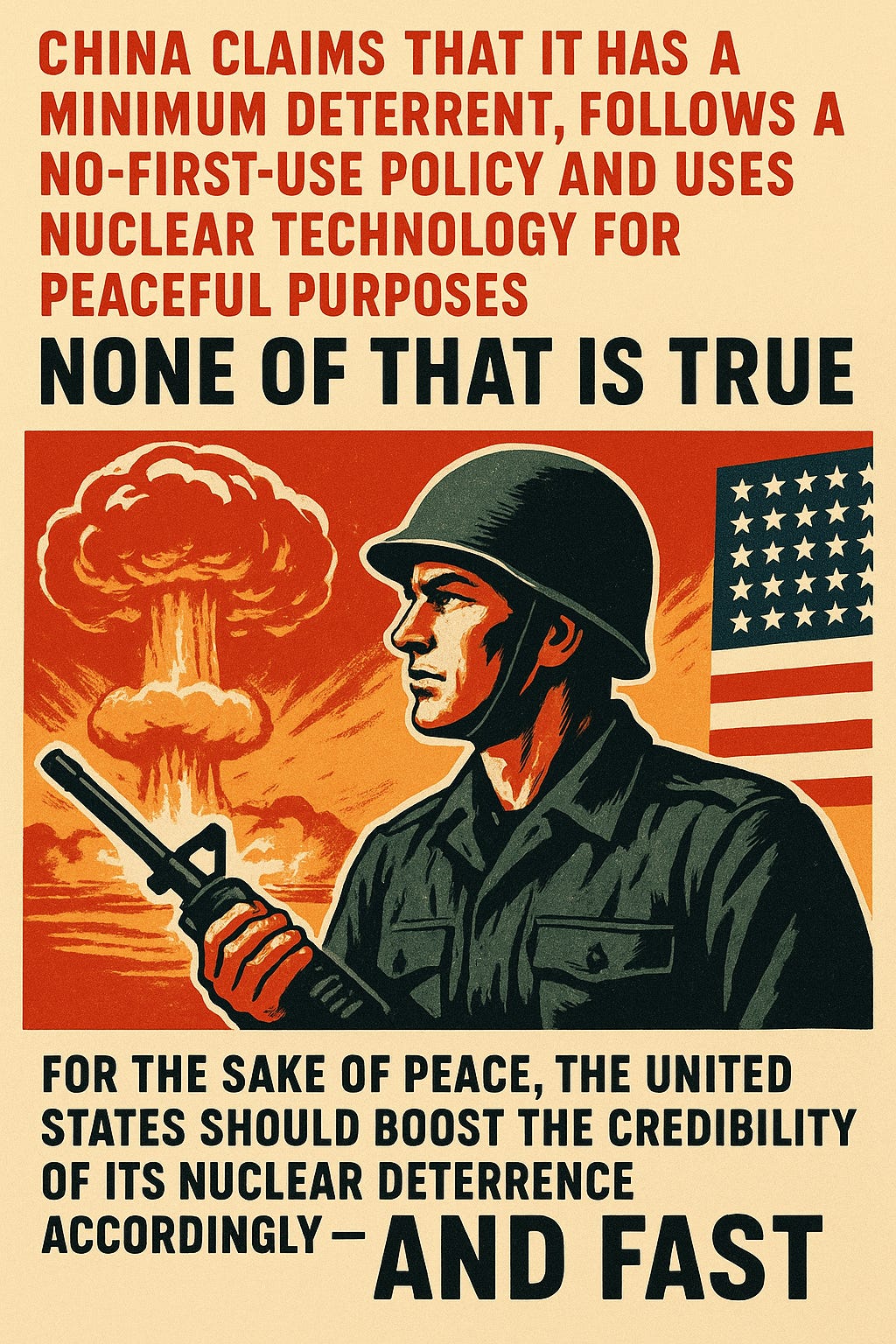
China claims that it has a minimum deterrent, follows a no-first-use policy and uses nuclear technology for peaceful purposes. None of that is true. For the sake of peace, the United States should boost the credibility of its nuclear deterrence accordingly – and fast.
Hey…we can just do things.