










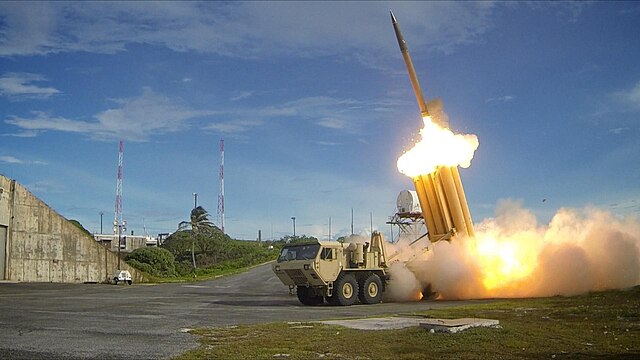
As the Trump administration weighs strikes on Iran following the regime’s brutal killing of protestors, it must reckon with a hard lesson from last June: in just 12 days of Israel–Iran fighting, U.S. and Israeli munitions fell to dangerously low levels. The Pentagon’s move to boost Patriot PAC-3 production from roughly 600 to 2,000 interceptors a year is a welcome start, but it is not enough. Even with this increase, the United States remains behind the curve. Washington and its partners must rapidly expand production and rebuild magazines of key munitions and interceptors, including proven Israeli systems.
Partly driven by Iran's decision to sharply accelerate ballistic missile production, Israel struck Iran with 4,300 munitions in just 12 days of war in June. Israel also expended significant numbers of Arrow, David's Sling, and Iron Dome interceptors co-produced with America, according to data from JINSA. The United States, helping defend Israel, fired 150 Terminal High Altitude Area Defense (THAAD) interceptors—about 25% of its total stockpile—and 80 Standard Missile-3 (SM-3) interceptors. During Operation Midnight Hammer against Iran’s nuclear facilities, the United States also used 14 GBU-57 bunker-busting Massive Ordnance Penetrator (MOP) bombs, a significant quantity of scarce munitions. Finally, to defend Al Udeid Air Base in Qatar against Iran's retaliation, U.S. troops fired 30 Patriot Advanced Capability-3 (PAC-3) interceptors.
Yet, the problem is not just that U.S. magazines are bare; it is that the United States lacks the capacity to refill them quickly. Production of all munitions—interceptors for THAAD, Patriot, Arrow, David’s Sling, and Iron Dome, as well as Joint Direct Attack Munitions (JDAMs) and 155mm artillery shells—is far slower than current combat use or anticipated future high-intensity war requirements. Replenishing THAAD shortages, for example, will take at least 1.5 years at current production capacity, not considering U.S. commitments to supply foreign partners, including Saudi Arabia. U.S. manufacturing lines, long optimized for efficiency to keep costs low during peacetime or periods of peace or low-intensity conflict, have not scaled for high-tempo operations in decades, let alone for the possibility of multiple simultaneous wars.
Read more here.










Sounds like a psy-op to me.